Bad Astronomy Blog has a reminder of the awesomeness that is The War of the Worlds. The very first commenter to his post referenced the 1978 concept album, and another showed us where to find an addictive montage of '70s cheese and fake UFO pics:
The chances of anything coming from Mars - The best video clips are right here
You have to wait until about 6 minutes into the video to get to the hook: Once Richard Burton gets a break from narrating, Ogilvy the Astronomer gets a tenor solo (courtesy of Justin Hayward) about his opinion of the chances of life on Mars. My dad own(s)(ed) this opus on vinyl LP, and I recall many a weekend marveling at the artwork and not realizing how cheesy it all was. (True confession: I bought the CD's on sale at Waterloo in 2002.) I dare you to listen to the whole thing, though. It's catchy.
Showing posts with label Book Reports. Show all posts
Showing posts with label Book Reports. Show all posts
Sunday, June 29, 2008


Tuesday, March 18, 2008
Remembering the greatest nerd of all time
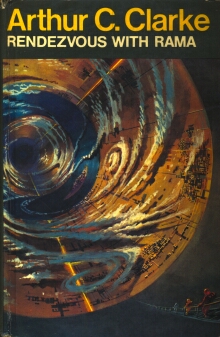
Sir Arthur C. Clarke, hero and icon to nerds and geeks alike, passed away today at the age of 90. I have been a fan since I first saw 2001 at the age of 7 or 8, and an admirer since I read Childhood's End and Rendezvous with Rama at the age of 13.

In addition to being a screenwriter and prolific author, he also first thought up quite a few things we find commonplace nowadays:

I'm also a big fan of Clarke's Three Laws:
See you out there in the universe, Sir Clarke.
In addition to being a screenwriter and prolific author, he also first thought up quite a few things we find commonplace nowadays:
Clarke also was credited with the concept of communications satellites in 1945, decades before they became a reality. Geosynchronous orbits, which keep satellites in a fixed position relative to the ground, are called Clarke orbits.
His non-fiction volumes on space travel and his explorations of the Great Barrier Reef and Indian Ocean earned him respect in the world of science, and in 1976 he became an honorary fellow of the American Institute of Aeronautics and Astronautics.
I'm also a big fan of Clarke's Three Laws:
I'm not sure there can be as fertile an imagination as his anytime soon. I hope the first people to venture beyond the moon do so at least partly in his honor. I'll bid him farewell with a little Also Sprach Zarathustra:
- When a distinguished but elderly scientist states that something is possible, he is almost certainly right. When he states that something is impossible, he is very probably wrong.
- The only way of discovering the limits of the possible is to venture a little way past them into the impossible.
- Any sufficiently advanced technology is indistinguishable from magic.
See you out there in the universe, Sir Clarke.
Thursday, September 20, 2007
Tolkien has nothing on this guy
If I may be permitted to geek out for a moment, I have become a huge fan of George R.R. Martin's series A Song of Ice and Fire. I'm about 2/3 through the second book, A Clash of Kings, which is followed by two more books and will eventually comprise a seven-part series. Time Magazine proclaimed him the "American Tolkien," but I really only give Tolkien credit for creating the genre and archetypes that other authors have put to better use. If you actually try reading The Lord of the Rings, it's not the easiest thing in the world--Tolkien was always more of an academian than an author. In my opinion, it took Peter Jackson to really breathe life into those characters.
A Song of Ice and Fire has its own extensive backstory, along with multiple languages, religions, and ideologies, that, much like Tolkien's work, make you believe there is really a huge body of research behind the novels. The books are much more readable, though, especially considering Martin's background as a screenwriter.
One thing the books really touch on that I like is the "ordinary" people--it's not all about lords and kings and all that. And even when it is, the characters are shown in full, with all their flaws, fears, and bodily functions. I remember reading Frank Herbert's Dune series and wondering, above all else, when his characters ever had time to eat and go to the bathroom. Then again, Martin's books don't have anything as cool as sandworms.
There is now talk of an HBO series based on the books. If cast correctly and given enough time (i.e. several seasons), that could seriously kick ass.
Here are some other scifi/fantasy/historical fiction sagas that I recommend, if you happen to have a lot of time for reading:
- Hyperion, by Dan Simmons
- The Camulod Chronicles, by Jack Whyte
- Harry Turtledove's alternate history series, where the South wins the Civil War, continuing through to the end of World War II (one plot spoiler: the equivalent of the Battle of Stalingrad is fought in Pittsburgh)
- Kim Stanley Robinson's Mars Trilogy (he finds a practical use for buckyballs!!!)
Thursday, June 7, 2007
The best book on global warming that wasn't actually about global warming


Nightfall, by Isaac Asimov--both a short story (1941) and a novel written with Robert Silverberg (1990).
I cannot speak to Asimov's original motivation in writing the short story in 1941, but the plot certainly seems relevant today in many ways: A group of scientists make discoveries strongly suggesting an impending global cataclysm, which much of society rejects. In this case, a planet lit by six separate suns, whose people have never known a moment of Darkness, faces an eclipse (during a period where only one sun is visible) by a heretofore-unseen moon, leaving half of the planet in total darkness for about fifteen minutes. During this time, the stars finally become visible for the first time in recorded history. For people who have an instinctive fear of any sort of darkness, this cause widespread insanity and the breakdown of civilization. A religious cult preaches that the Stars are divine punishment for the sins of humanity and predicts the End of the World. In desperation to get some source, any source of light, panicked humans set fire to the cities. It turns out that this is a repeating cycle: the same eclipse occurs every 2,049 years, with approximately the same results each time.
Luckily, we are not headed for any comparable conflagration anytime too soon, but these stories are some interesting food for thought.
Subscribe to:
Posts (Atom)


